Baypen plant
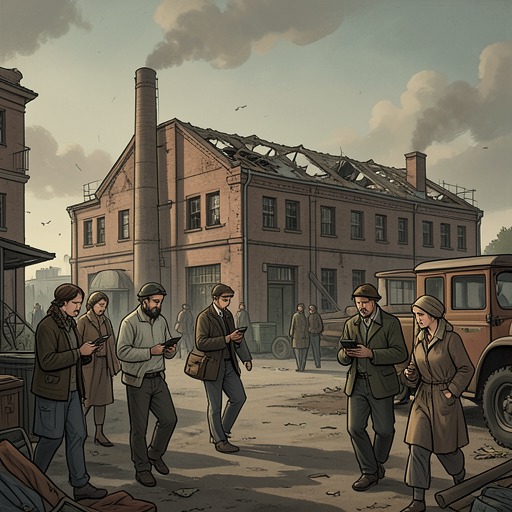
Clown in a CornfieldThe Baypen plant is a burned industrial site that Sheriff George Dunne presents as the center of Kettle Springs’ proposed rebirth. Its damaged loading dock still opens, and a mural of Frendo over the bay door transforms the factory’s entrance into a physical emblem of the revival the conspirators intend to impose.
Fire and the Revival Plan
The plant’s fire is already charged with suspicion before Sheriff George Dunne brings Cole Hill back to it. Ronnie Queen tells Cole that she and the others know the Baypen factory fire was not an accident, citing Tucker Lee’s report that Cole wanted to die inside. Cole rejects the accusation, saying that they were drunk and that he is not suicidal. The exchange ties the factory to Cole’s grief and self-destructive behavior without resolving the dispute over his intentions.
Later, Sheriff George Dunne explains how the fire and the Founder’s Day stunt helped turn local fear into support for action. For months, organizers had gathered people they believed would listen and had a role to play, gradually drawing them into the Kettle Springs Improvement Society without disclosing the full plan to everyone. Dunne says the Founder’s Day stunt convinced people that they needed to act quickly. He also admits that Dr. Weller, initially one of their most vocal supporters, threatened to expose them; the group dealt with that threat together.
Dunne casts the plant’s reopening as proof that his scheme has succeeded: Baypen has reopened, and Kettle Springs, in his telling, has been saved. His promise of renewal is inseparable from the violence and coercion he has just described. Cole answers with the slogan that Frendo wins, while Dunne adds that a little drop of Baypen makes everything better, turning the company’s product and the clown figure into paired emblems of the future he claims to be building.
The Factory Floor
When Dunne drives Cole to the plant, the car is not heading back to town. He presses a garage-door opener strapped to the dashboard radio, and machinery starts somewhere ahead. The loading-dock shutter still operates despite the fire: its gears move against rust and heat-warped parts. The damaged mechanism makes the plant’s survival concrete, but also keeps the fire’s damage visible in the very act of opening the way inside.
Above a double-wide bay door is a giant mural of Frendo, its face charred. As the steel shutter rises, it seems to form the clown’s open mouth. Dunne drives his cruiser onto the factory floor and switches off the engine and lights. A few fluorescent lights to the right illuminate the stairs to the foreman’s office; most of the floor remains dark. The entrance thus leads not into a restored, welcoming workplace, but into a burned and shadowed space under the image of the figure Dunne’s plan celebrates.
Narrative Significance
The plant joins the story’s competing accounts of destruction and renewal. Cole associates being inside it with the fire and rejects the claim that he wanted to die there; Dunne instead treats its reopening as evidence that the town has been saved. Yet the rusted gears, heat-warped parts, charred mural, and dark factory floor qualify that rhetoric. Baypen may be reopening in Dunne’s account, but the site’s damaged material presence remains: the promised fresh start is entered through a burned threshold beneath Frendo’s open mouth.